Home/Fabrication/Illuminated signs
Illuminated signs
Channel letters, illuminated cabinets and acrylic faces, bent, assembled, wired and burn-tested in our Saint-Bruno-de-Montarville shop, then delivered across the South Shore and Montreal.
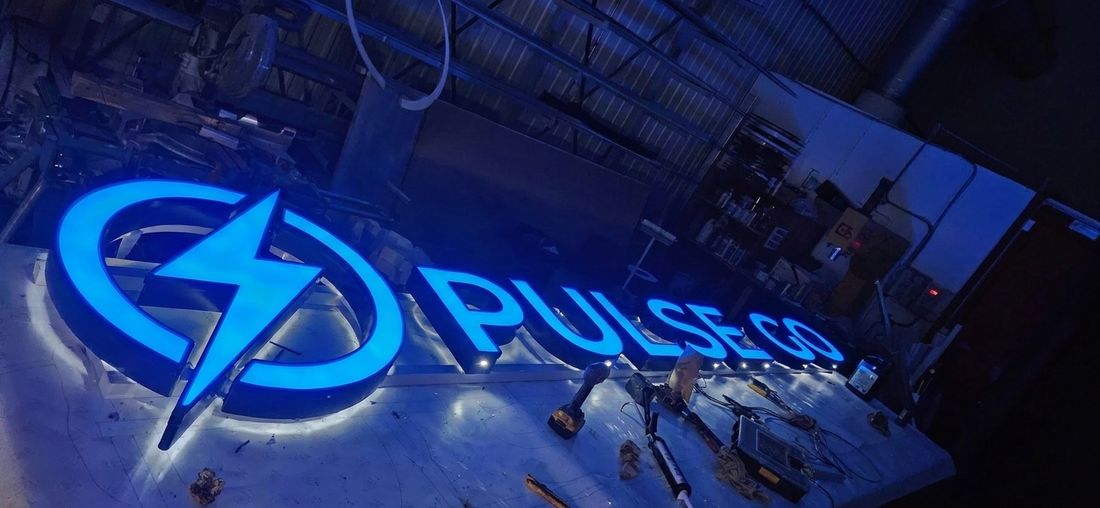
Three ways to light a letter
A channel letter lights through the face, out the back, or through the sides. That choice decides what the sign looks like after dark, and it's the first thing to settle, before anyone talks about materials.
Face-lit. A translucent acrylic face with LEDs behind it: the face is what lights up. The returns stay opaque: on a standard channel letter the sides do not glow. This is the retail classic and the most legible from a distance.
Backlit (halo). The face is opaque (usually aluminum) and the light spills out the back against the wall. The letter stays dark, ringed in a halo. Quieter, more upmarket, and a favourite for offices and clinics.
Side-lit. The returns are translucent, so light comes out through the sides, on its own or alongside the face. The letter then reads from every angle, including on the skew along a storefront.
How we build them
The return (the side wall of the letter) is cold-formed from aluminum coil on our bender. Corners are notched and clinched, riveted or welded, which gives a crisp edge that doesn't open back up through freeze-thaw cycles.
Faces are CNC-routed from cast acrylic, then trim-capped or flush-bonded depending on the finish you're after. LEDs are energy-saving, high-efficiency modules laid out at a calculated pitch so you don't get hot spots reading through the face.
Painted returns and faces come out of our own booth on the AkzoNobel Grip-Gard system: the line built for sign work, not a generic coating.
Every sign is wired, lit and left running on the bench before it gets packed. That's the step an inspection finds out about when it's been skipped.
Four ways to hang the letters
This gets settled early, because it changes how many holes go into the facade, what servicing costs later, and how the sign reads in daylight.
Direct to wall. Every letter is drilled and fixed individually, so the wall shows between them. The cleanest look, and the most holes in the facade, which some landlords will not allow.
On a raceway. An aluminum box roughly 5 to 8 in deep, fixed along the length of the sign, holding the wiring and the power supplies. One hole through the wall, and a failed supply is replaced by lifting the cover.
On a wireway. Slimmer than a raceway and carrying only the wiring; the power supplies sit inside the wall. Tidier to look at, but the day a supply fails the sign has to come off the building to reach it.
On a backer. A shallow aluminum box (1 to 4 in, most often 2 in) with an open back and a clean front, which the letters mount onto. Unlike a raceway it is meant to be seen: cut to shape and painted, it becomes a frame that lifts the lettering off a busy facade.
Put simply, a wireway costs you at install, a raceway costs you at service, and a backer is first of all a design decision. Tell us which matters most for the building and we'll build to it.
What UL certification actually gets you
Our shop holds its own UL file (E511960), and our illuminated signs are built with c UL us Listed components: power supplies, LED modules, wiring and grounding. This isn't a decorative claim: most municipalities on the South Shore and in Montreal require it at permit stage, and an insurer can decline a claim on a non-compliant sign.
We also hold R.B.Q. licence 5778-2740-01, which is what general contractors ask for before they'll put a sign supplier on a job site.
Frequently asked questions
What's the difference between channel letters and a lit cabinet?
A channel letter is an individual letter, built one at a time and mounted straight to the wall, so the wall shows between letters. A cabinet is a single box with the artwork printed or applied on its face. Channel letters cost more and look sharper; a cabinet is cheaper and lets you change the graphics without rebuilding the structure.
Do you install, or only fabricate?
We fabricate only: we don't install. Most of our clients are sign professionals who install themselves: the sign arrives packed and ready to mount, with the drill pattern and wiring diagram, for your crew or your installer.
How long does an illuminated sign take?
Usually two to four weeks from proof approval, depending on size and finish. Real lead times hinge mostly on acrylic and aluminum supply: we give you a date at quote time, not a vague range.
Do I need a permit for an illuminated sign?
Almost always, and the rules vary from one South Shore municipality to the next. The permit is applied for with the city where the sign will be installed. We supply the dimensioned shop drawings the city needs to process it.
Send us the file.
Artwork, drawings or site photos: a price and a delivery date within 24 to 48 business hours. In the sign trade? See our wholesale program.